

The visit you record becomes the note you sign and the claim you send.
Crebral Health listens to the visit, drafts the note while you talk, coaches the documentation to what payers actually pay for, and sends the claim. One chart, built around your specialty, with the scribe included rather than sold on the side.
Audio never leaves the device · every suggestion cited · the clinician signs every note and owns every claim.
One conversation in. A signed note and a clean claim out.
The visit is the only input. The note is drafted from it on your specialty's template, and the claim is built from the signed note. By the time you sign, the claim has already been checked.
Crebral Scribe on iPhone, iPad or Mac. Consent first, then the visit. Nothing is uploaded; the practice keeps the audio.
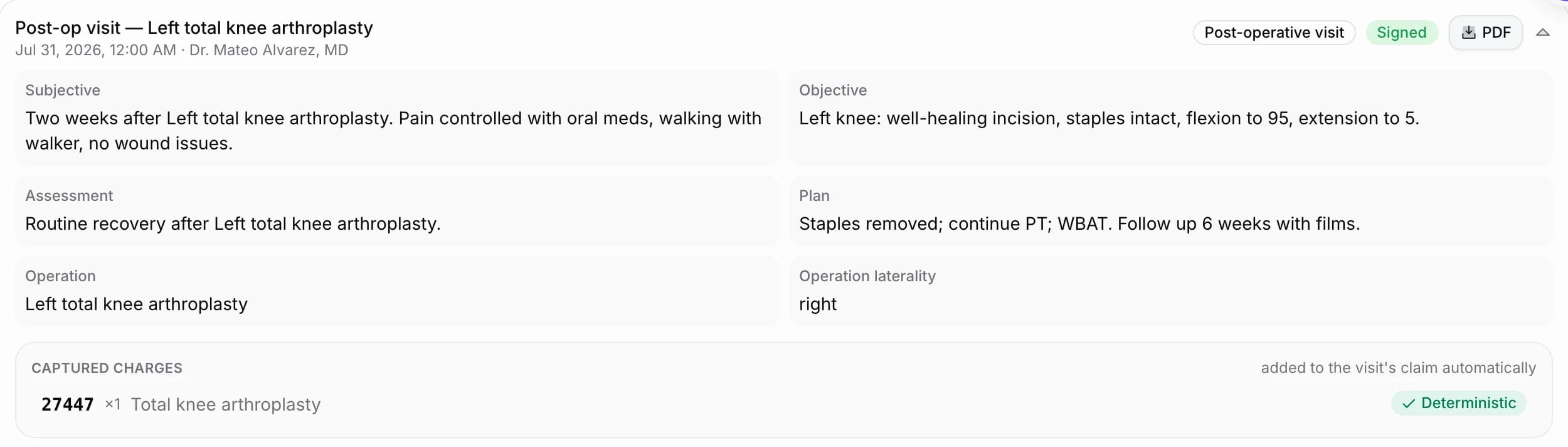
Drafted on your specialty's template, every line traceable to the visit, nothing invented. You review and sign.
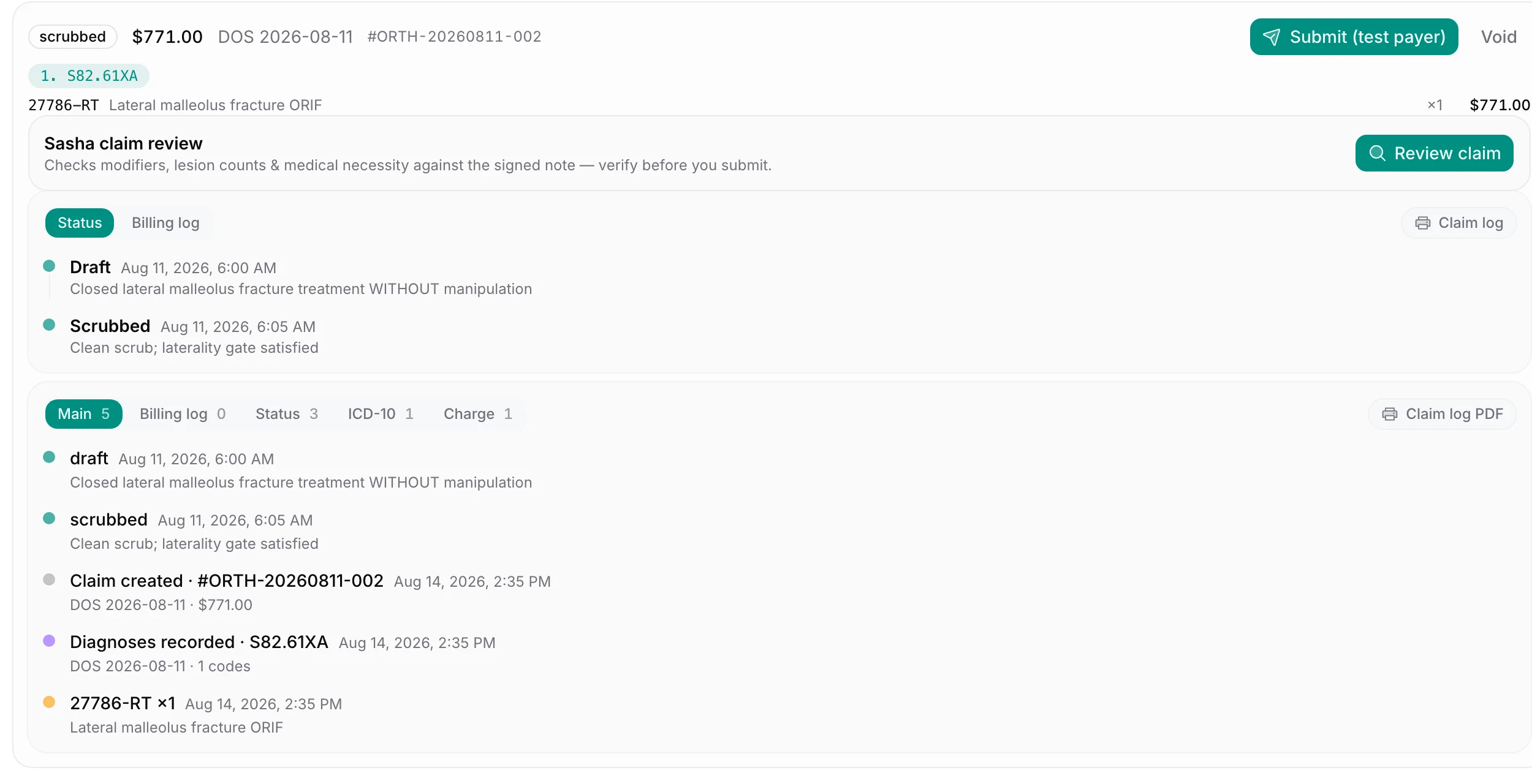
Codes and modifiers come from the note. By the time you sign, the claim has been checked against what payers bounce, and it goes out clean.
One platform. 5 practices that feel native.
A vertical is not a skin. Chart tabs, note templates, lab ranges, visit types, coding rules and pricing are resolved for your specialty on the server, so every surface reads the way your practice already thinks.
Documentation that pays for itself.
Reimbursement lives and dies on what the note says, so the platform asks for the specificity a payer needs while you can still add it and checks the claim against the signed note before it leaves. The revenue cycle itself is a service of its own: run it in the chart with your own team, or hand it to Crebral Billing and pay a share of what we collect, the way the best billing companies price.
Coaching in the note, not after it
The documentation coach speaks up under the field it means. "Heart failure" becomes acute-on-chronic HFrEF while you're still writing, never in a query three weeks later.
Claim audit with the sentence that proves it
Before a claim leaves, it's checked against the signed note and the finding quotes the line that supports it, or the line that doesn't. Modifier necessity, lesion counts, bundling and laterality, cited.
Expected reimbursement, not guesswork
Every line carries what you can expect to be paid, from real fee schedules and your own payer history. The charge is never the allowed, and you see the difference before you submit.
Crebral Billing, the managed service
Our billers work your claims, remittances, denials and follow-up inside the same chart your clinicians use, with nothing to export and nothing to re-key. Priced as a percentage of collections, so we are paid when you are. Talk to us about your practice.
The payer pays you. Not Crebral.
Here's the path a claim takes from the visit to your bank account, and how a deposit stays tied to the remittance that explains it.
The signed note becomes a claim, already checked before it goes out.
Submitted as an 837P through our clearinghouse partner, Stedi.
They decide what each line is worth and what adjusts.
The 835 says what paid, what was adjusted, and what the patient owes.
By EFT or a paper check, straight to your practice, never through us.
Posted against the visit, denials routed to your biller, the patient's balance updated.
Where the money goes
Payers pay your practice directly. Crebral never holds, touches or moves the money, and we never sit in the flow of funds.
Matched by trace number
One payer deposit usually covers many claims. The 835 and the deposit carry the same trace number, the EFT trace or the check number, and that's how a deposit gets tied to the claims it paid. With direct deposit through Stedi Treasury the match happens for you; without it, a biller lines up bank statements against remittances by hand.
What Crebral never does
We don't hold your funds, and we don't sit between a payer and your bank account. We set up the matching, not the custody.
A complete chart, built around the visit.
Not a generic EHR with a specialty skin. Every surface exists so the visit, the note and the claim stay one record, and the practice runs around it.
Labs that file themselves
SMART-on-FHIR and PDF ingest land results in the trend, scored against the ranges your specialty uses. Click any value for the full history.
Scheduling
Your specialty's visit types out of the box, drag-to-reschedule, 15-minute precision.
Worklists that find the gap
Overdue recalls, pathology waiting on a result, denials waiting on a person. The chart keeps the schedule, not a spreadsheet.
Charts per specialty
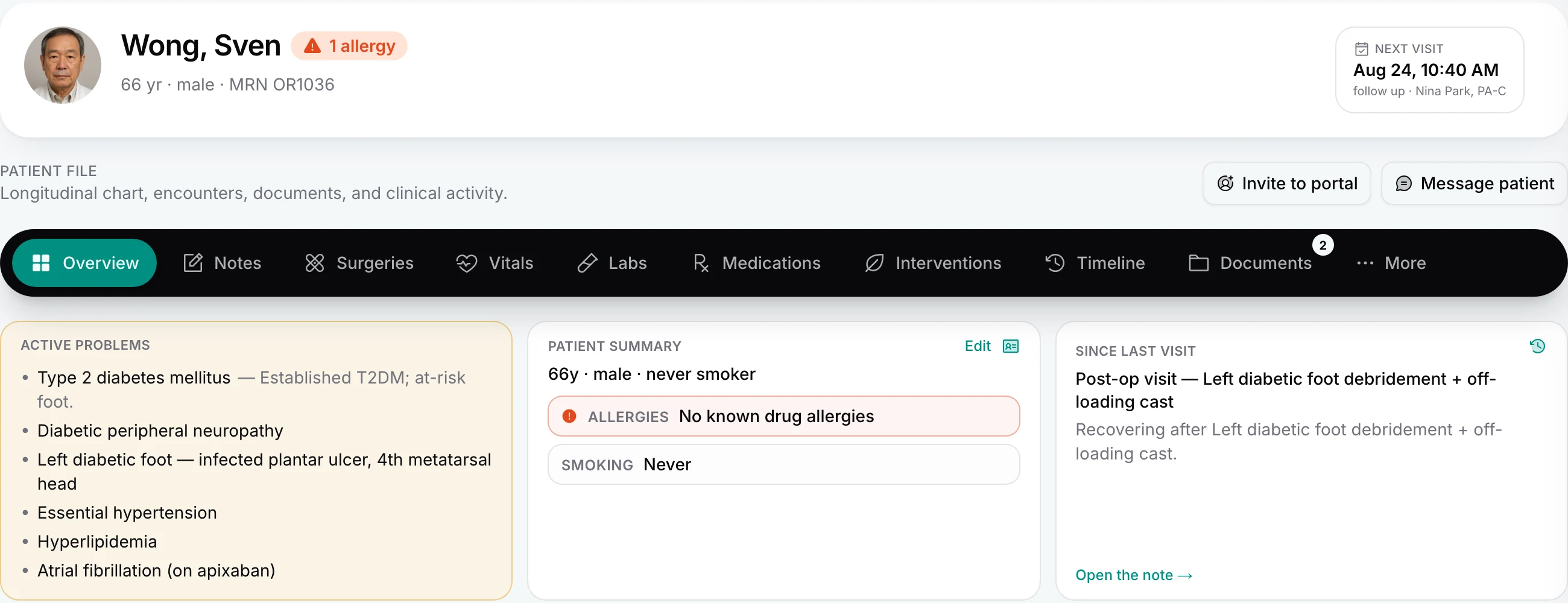
Problems, medications, allergies, surgeries with global periods, a 3D body map, documents: the tabs your vertical needs and none it doesn't.
Intake and portal
Magic-link intake straight into the chart, a white-label portal with messaging, and wearable trends beside the labs.
Documents that sort themselves
Reports, referrals and consents are classified and summarized on upload and attached to the right patient.
Ask the chart a question. Get a cited answer.
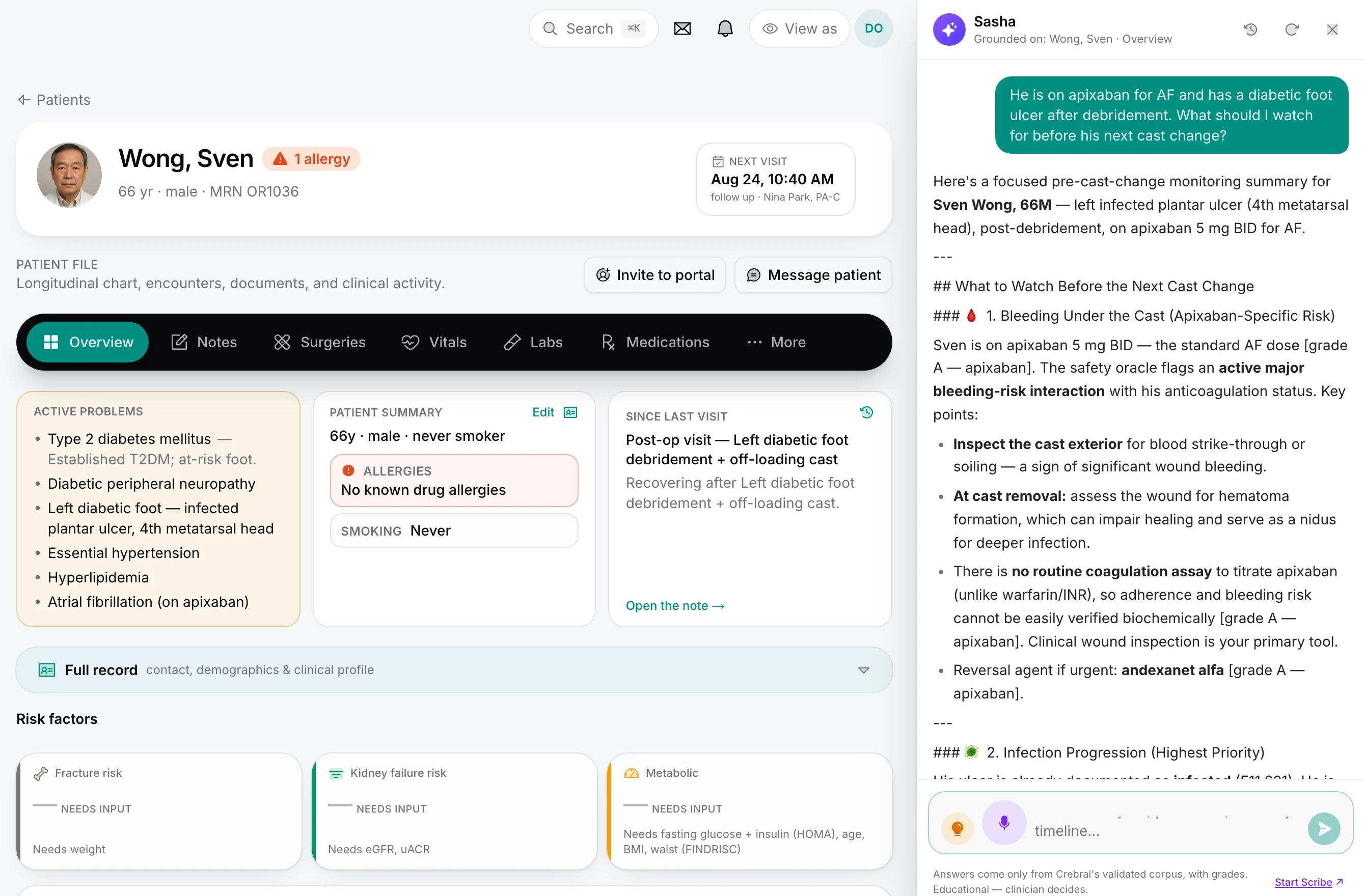
Sasha is grounded on the patient you have open and answers only from Crebral's validated corpus, with the evidence grade on every claim. When the record can't support an answer, Sasha says so instead of guessing. The clinician decides.
The scribe that never uploads.
A native app for iPhone, iPad and Mac. It sits in the room, listens, and the note is ready when you walk out. Your recordings never leave the practice, and nothing reaches the chart that the visit didn't support. It comes with every plan. Everywhere else the scribe is a second subscription on top of the EHR, priced per clinician. Here it is the front of the same system, so the note it drafts is the note the coder reads and the claim is built from.
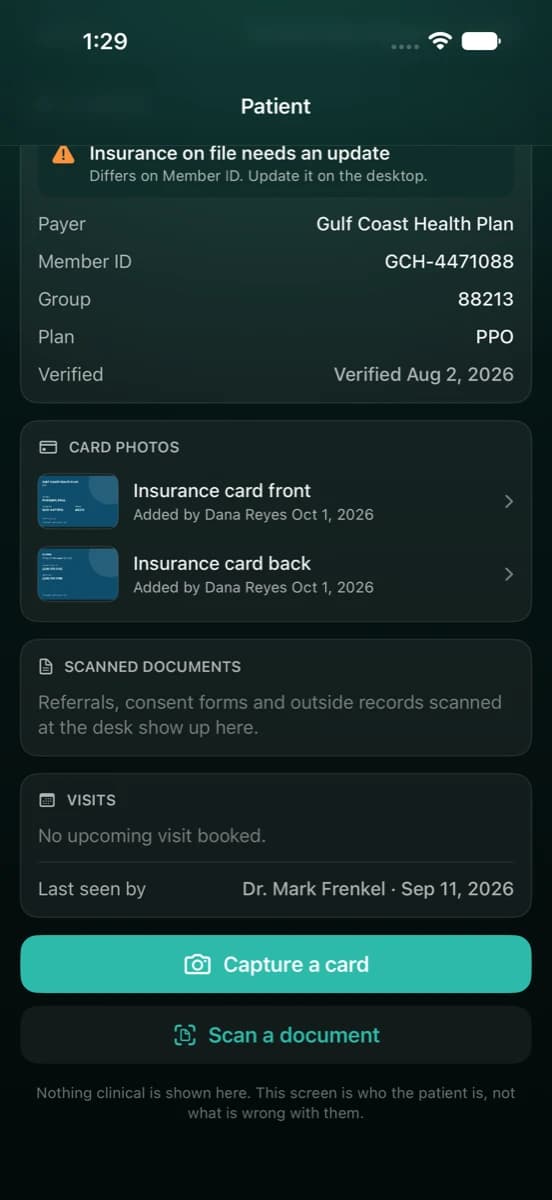
Check-in scans the card. The chart already knows.
Every practice we visited last year asked for a photo of the insurance card by email. That parks it in two consumer mailboxes permanently, outside the BAA and outside retention. The same app your clinicians record with fixes it at the source: the desk scans the insurance card and the photo ID at check-in, front and back, and they land on the patient's record. The card is then read and checked against the coverage on file, so a member id that changed over the summer surfaces at the desk instead of on a denial three weeks later.
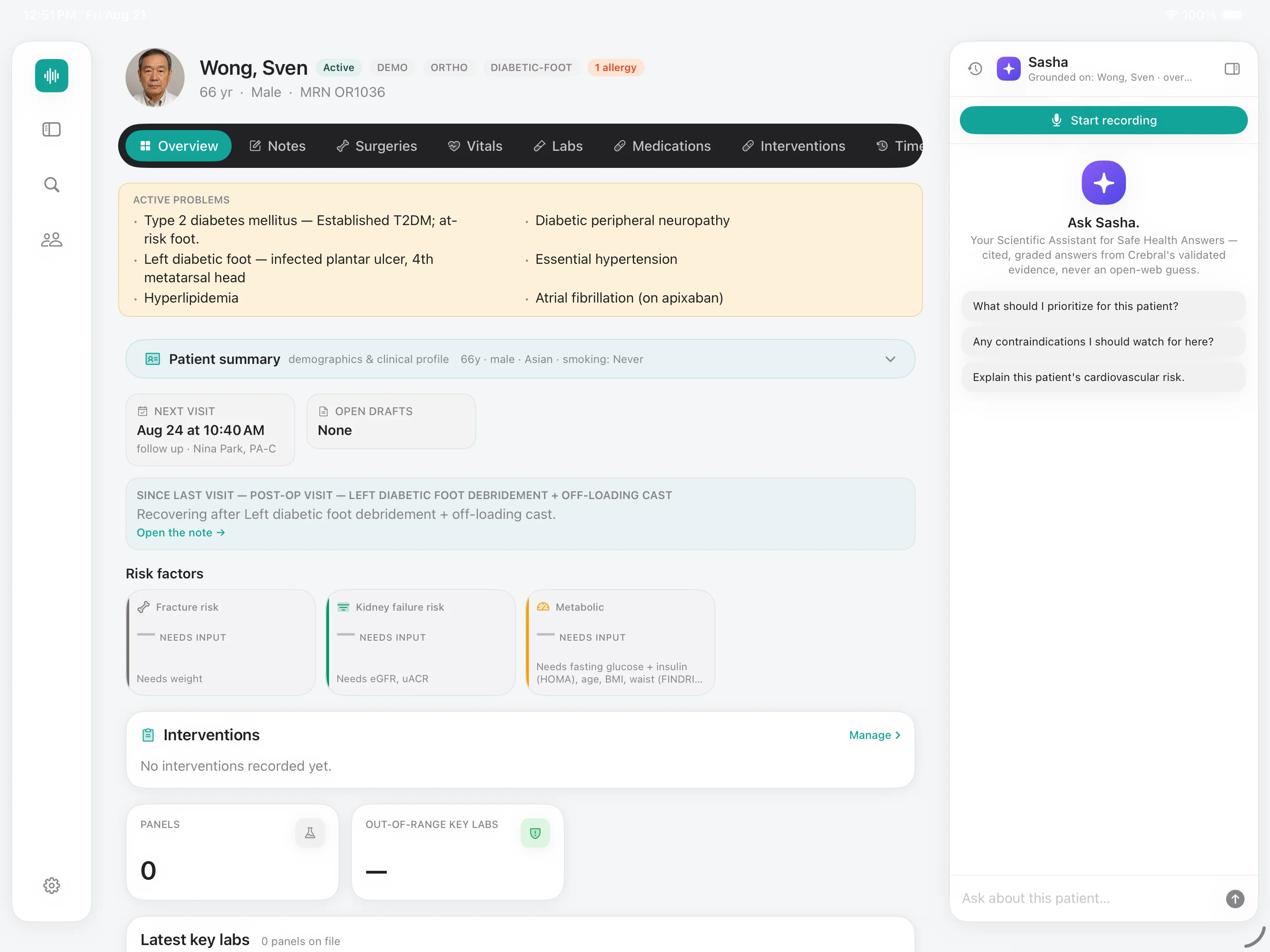
Deterministic checks and cited answers, not a chatbot guess.
Two things sit under every suggestion on the platform: a rule engine that screens every therapy on the ledger for interactions and contraindications with its source shown, and a graded evidence corpus the assistant answers from. When the evidence isn't there, it says so.
Interaction checks on every therapy
Interaction and contraindication rules built from FDA labels and graded evidence, each with its source, run against everything on the intervention ledger, including what another clinic started. Coverage is deepest in longevity and metabolic medicine and is growing by specialty. Overridable by the clinician, never silently.
Validated risk models
PREVENT, ASCVD, FIB-4, PhenoAge and the rest, each reproduced against its reference implementation before it ever renders on a chart, and resolved per specialty so a bunion patient never sees a dementia score.
Sasha, grounded
The assistant knows which patient you're looking at, answers from graded, cited claims, and checks anything it raises for interactions first. Same assistant on web, iPad and desktop.
Honest grading
Every claim in the corpus carries its grade and a peer-reviewed or frontier flag. Where the science is contested, the counter-evidence is on the record rather than dropped.
One price, whatever you practice.
A platform base with one clinician included, then a seat each. Every plan carries the ambient scribe, coding with the documentation coach, interaction checks, claims, a HIPAA BAA, and the chart built for your specialty. Nothing is sold on top per clinician. The scribe that costs extra everywhere else is the first step of the visit here.
- +$299 per extra seat, monthly or annual
- Works out from $299 per clinician as you grow
- Ambient scribe on iPhone, iPad and Mac, included, not an add-on
- AI coding with the documentation coach
- Interaction checks on every prescribed therapy
- Specialty chart, note templates and lab ranges
- HIPAA BAA included
- Everything in Practice, plus:
- SSO (SAML / OIDC) and audit logs
- HL7 FHIR and custom integrations
- Dedicated CSM and SLA
- Guided implementation
If you bill insurance
Billing is not part of the seat, and it is on a meter you can see. Each plan carries 250 claims and 500 eligibility checks a month, then per use. Or let Crebral Billing run the revenue cycle for a share of collections.
If you are cash-pay
Longevity and wellness practices get the evidence engine instead of a billing stack: 20 graded programs a month, then $12 each. Nothing to buy for claims you do not send.
Same base and seat in every specialty. See what each one gets. Prices in USD; taxes may apply. Generated notes, codes and programs are drafts the clinician reviews, edits and signs.
Drafted by the platform. Signed by you.
Nothing here replaces judgment. The scribe drafts, the coach suggests, the oracle flags, and every one of them shows its source. The clinician signs the note and owns the claim.
Audio never leaves the device
No audio upload, no third-party transcription service, no analytics code in the app. Text is the record.
Human-in-the-loop, everywhere
Codes are advisory and never auto-billed. Notes file unsigned. Programs are drafts. Every field is yours to change before anything is final.
Educational, not medical advice
Crebral Health is a research and education platform. The practitioner reviews and owns every plan, note and claim.
Run your next visit through Crebral.
Take consent, talk to your patient, sign the note. The claim is already built, and the whole clinic runs around it.